Kashi Cereal Lovers Red-Faced Over Company’s “Natural” Claims

A Rhode Island store pulled Kashi cereal from its shelves and posted a sign about it. Now a photo of that sign has gone viral.

Posted by Emily Leaman on 4/26/2012 at 1:35PM | 14 Comments
Text Size: A | A | A

“You might be wondering where your favorite Kashi cereals have gone. It has recently come to our attention that 100% of the soy used in Kashi products is Genetically Modified, and that when the USDA tested the grains used there were found to be pesticides that are known carcinogens and hormone disruptors.”

That’s the sign posted in the cereal aisle of a Portsmouth, Rhode Island grocery store called the Green Grocer. It’s been hanging there for a few months, but earlier this week, someone snapped a photo and posted it to online—and then it went viral.

Let’s back up for a minute. John Wood, who owns the store, actually removed the Kashi products from his store back in February, after reading a 2011 report from a group called the Cornucopia Institute, an advocacy group that supports organic farmers. The report states that only four of Kashi’s 24 cereal products are actually certified organic and that Kellogg, the umbrella company that owns Kashi, “purchases genetically engineered ingredients for its ‘natural’ Kashi products,” including chemically processed soy.

When Wood got wind of this, he pulled most of the Kashi products from his shelves and posted the sign. Photos of the sign were posted online this week—and now people are pissed.

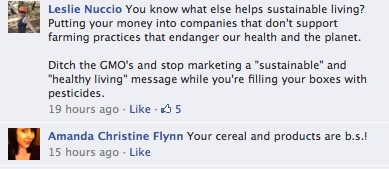
Angry Kashi customers have been taking their frustrations to the company’s Facebook wall, posting hundreds of comments. Two examples:

The company responded yesterday by posting a video in which a Kashi nutritionist named Keegan comments about the “inaccurate information being circulated online about Kashi ingredients.” She explains that “while it’s likely that some of our foods contain GMOs”—that’s genetically modified organisms—”the main reason for that is because in North America well over 80 percent of many crops including soy beans are grown using GMOs. Factors outside our control … have led to an environment where GMOs are not sufficiently controlled.” She goes on to say that last year Kashi partnered with the Non-GMO Project, a third-party group that independently tests food for GMOs. The project recently deemed seven Kashi cereals to be GMO-free, with potentially more on the way as the verification process continues.

“The information circulating is scientifically inaccurate and misleading,” Keegan says, “because it was not based on testing of actual Kashi products but instead on general USDA data. We’re confident that our products are free of substance that would pose a health risk to our consumers.”

Maybe, but it still raises questions about product marketing and labeling practices. While products labeled as “organic” are federally regulated, most that claim to be “natural” are not. (The exception are meat and poultry products, which are USDA-regulated.) So labels claiming a food is “natural” or “all-natural” are, well, kind of meaningless as far as consumers are concerned. Last year, someone brought a class-action suit against Kashi for its having “falsely and misleadingly labeled virtually all Kashi products as ‘all natural’ or containing nothing artificial even though the products allegedly do not conform to applicable federal regulations and policies on ‘natural.’”

I’m not trying to single out Kashi here (I don’t eat the stuff, so it’s neither here nor there as far as I’m concerned), but the brouhaha is a good case-in-point for arguing that food manufacturers need be more responsible in how they label and market their food—that there has to be a standard across the board so consumers can be certain that “natural” on the front of a box of crackers means the same as “natural” on Kashi cereal.

Someone has to hold them to a higher standard—whether it’s the USDA, FDA, or angry consumers on Twitter and Facebook.

  • Share/Bookmark
 
READ MORE: Healthy Eating, News

User Comments:


  1. bridget says:

    I never assume anything is chemical/pesticide and GMO free unless it is labeled as ORGANIC, period. All natural means nothing. Read the ingredients on the label and educate yourself.

  2. Paul Marokus says:

    Amen.

  3. sharon says:

    regarding this statement: ….in North America well over 80 percent of many crops including soy beans are grown using GMOs. Factors outside our control … have led to an environment where GMOs are not sufficiently controlled.” This is a factual statement…this is where our anger should be directed!

    • untue says:

      Great post at Kashi Cereal Lovers Red-Faced Over Company’s “Natural” Claims | Be Well Philly. I was checking constantly this blog and I’m impressed! Extremely helpful info specifically the last part :) I care for such info a lot. I was looking for this particular information for a long time. Thank you and good luck.

  4. Mel says:

    Pretty sure “organic” holds no weight either. As far as I’m concerned nothing in his world is contaminant free…. How about that acid rain that falls on our crops, or the pollutants circulating underground and in the soil from unknowns before….. The contaminated bugs that fly and die in the fields and turn to earth… Minuute in consideration but in large quantaties add up overtime. Face it unless you grew it in virgin soil untouched with purified water who’s to say it’s organic or all natural or whatever else false label you want on it. Let’s start making labels like this does not intentionnaly contain MAN made products.

  5. [...] The Kashi controversy went viral last week after a Rhode Island grocer removed the cereal from his shelves, replacing it with the following note: [...]

  6. Really? says:

    Why should we bother creating objectively verifiable food labeling standards when people like you are only going to misinterpret them anyway? From the USDA’s website: “Organic agriculture practices cannot ensure that products are completely free of residues; however, methods are used to minimize pollution from air, soil and water.” Organic agriculture was conceived primarily as a certification for ecologically responsible farming practices; but it became popular with consumers who conflated it with some mythical kind of purity that would make you live forever.

  7. [...] Kashi Cereal Lovers Red-Faced Over Company’s ‘Natural’ Claims [...]

  8. Libby Schopp says:

    Shame on you Kashi. …and shame on me for believing your claims – should have known better. If it’s too good to be true… just saying…

  9. Libby Schopp says:

    Shame on you Kashi… …and shame on me for believing your claims. If it’s too good to be true…
    …just saying…

  10. abe alpert says:

    The bottom line is this we have to become more vigilant. These giant corporations are always trying to cash in. They know that many consumers, who want to be healthy, are just not paying that much attention.

  11. theman says:

    How about the Employees working for peanuts overseas to pick some of the fruits and ingredients needed. They work 10 to 14 hours a day overseas for peanuts. Barely feeding their families…..Why do u think they go overseas to gather alot of their ingredients…..exploit local population, barely pay them anything…..for us here to enjoy their hard work….or do you think they get paid American wages? It is unfair…..Just my thoughts…Its funny that in the commercials they are all happy, but I am a world traveler and know how much these poor people have to work to earn a meager existence…..It is a shame. I love natural foods too and eat the on a daily basis, but, to exploit another culture to get it, is not a good way to get what we want…..

  12. mmm says:

    Don’t sell your product as all natural if you are not.That’s why people are pissed!
    if you want to side with GMO- then don’t have commercials catering to health nuts…


2 WAYS TO COMMENT (CHOOSE ONE)
1. Share your comments with your Facebook friends:
2. Leave a Reply: